
Traditional mechanical keys work fine until you have fifty employees, three entrances, a warehouse door and the employee who walked out yesterday still has the key to the offices. That is why key fob systems work.
Instead of re-cutting new keys and rekeying the building’s locks over and over again, business employers are issuing electronic key fobs which are programmed by an access control system.
These access control systems can limit access from one door in a single office to as many doors spread across multiple locations as are needed.
However, not all systems are built the same, and prices vary greatly among options. Below are some key points your business should know before selecting a key fob entry system.
What is a key fob system?
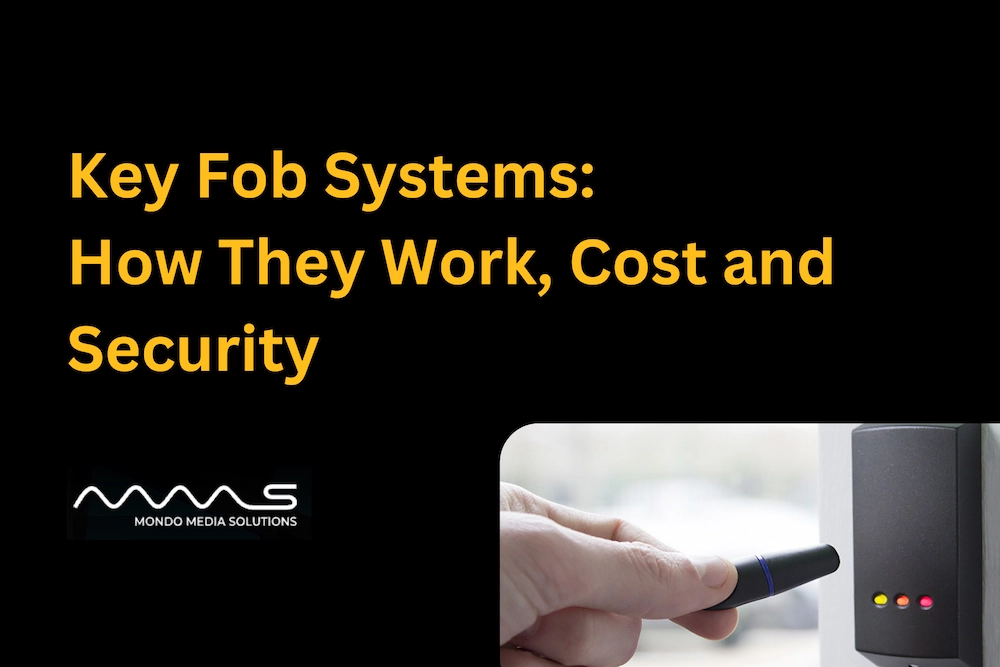
An electronic access control system that uses a key fob-like credential, carried by an authorized user, to unlock and control access to doors.
The employee taps the key fob up to a reader where it is identified to the access control system by an electronic code.
If access is permitted, the controller triggers the lock to disengage, allowing the employee access to secure locations.
A typical key fob access system includes:
- Electronic key fobs
- Door readers
- Access control panels or controllers
- Electric strikes or magnetic locks
- Door position sensors
- Request-to-exit devices
- Power supplies and backup power
- Cabling and network connections
- Access management software
The important point is that the fob itself does not unlock the door mechanically. It identifies the user to the access control system.
How do key fob systems work?
The process happens in seconds.
- The Employee Presents the Fob
The employee places the fob close to the reader. Depending on the technology, the credential may use RFID, NFC or another contactless technology to communicate with the reader. - The Reader Captures the Credential
The reader receives the credential information and sends it to the access control system. - The System Checks Permissions
The controller or cloud platform determines whether that credential is allowed through that specific door. Rules can be surprisingly detailed.
An employee might have access Monday through Friday from 7 a.m. to 7 p.m., while a facility manager has 24-hour access. - The Door Unlocks
If access is approved, the system temporarily unlocks the door. If access is denied, the door stays locked and the event can be recorded. - The Event Is Logged
Modern key fob systems create an audit trail showing which credential was used, at which door and when.
For businesses managing employees, contractors, visitors or restricted rooms, those records can be extremely useful.
What is the Cost of a Key Fob System?
Commercial access key fob installation costs typically start in the low thousands of dollars and will increase with door conditions, desired system complexity.
Current U.S. pricing guides place many complete commercial card and fob installations around $1,500 to $3,500 per standard controlled door. More complicated commercial openings can cost substantially more. Mondo Media Solutions’ broader access control pricing guide uses a planning range of approximately $1,500 to $8,000 per door depending on hardware and installation complexity.
These numbers should be treated as budgeting guidance, not quotes.
Typical Key Fob System Cost Factors
| Cost Factor | What Affects Pricing |
|---|---|
| Door hardware | Electric strike, maglock, crash bar, automatic operator |
| Reader | Basic proximity, smart credential, multi-technology reader |
| Controller | Single-door, multi-door, cloud or on-premise |
| Wiring | Distance, walls, ceilings and existing cable pathways |
| Credentials | Number and type of fobs required |
| Software | Cloud subscriptions, licenses and management features |
| Integration | Cameras, alarms, elevators, gates or visitor management |
| Labor | Installation difficulty, programming and testing |
A straightforward interior office door is usually less expensive than an exterior entrance, elevator, parking gate or complex fire-rated opening.
Are Key Fob Systems Secure?
Yes, but only when the right technology is selected and configured properly.
This is an area where buyers should ask more questions.
Older proximity credentials can offer weaker protection than newer encrypted smart credentials. Reader-to-controller communication also matters.
The Security Industry Association recommends Open Supervised Device Protocol or OSDP, as a modern access-control communication standard. OSDP supports secure communication, supervision, interoperability and stronger cybersecurity compared with legacy Wiegand connections.
For businesses planning a new system, the Security Industry Association OSDP guidance is a useful independent resource for understanding modern access-control communication standards.
Key Fobs vs Cards vs Mobile Access
Businesses now have more choices than just cards and fobs.
| Credential | Best For | Main Consideration |
|---|---|---|
| Key fob | Offices, warehouses and everyday employee access | Easy to carry and replace |
| Access card | Companies using employee ID badges | Larger physical credential |
| Mobile credential | Modern offices and multi-site organizations | Requires compatible phones and platform |
| PIN | Small or lower-risk areas | Codes may be shared |
| Biometrics | Sensitive or highly restricted areas | Higher cost and privacy considerations |
Many businesses use more than one credential type.
Employees may use mobile credentials while contractors receive temporary fobs. Other companies prefer physical fobs because they are simple and familiar.
A flexible key fob access system can support both current employees and future credential technologies without requiring a complete replacement.
Plan the System Around the Building, Not Just the Fob
Choosing between key fob systems should start with the doors, users, security risks and daily workflow.
Look at how many people need access. Decide which areas require tighter control. Consider whether cameras, elevators, gates, alarms or visitor systems need to work alongside access control.
Then discuss future expansion.
A good system should not become obsolete because you added another office or six more doors.
Mondo Media Solutions provides commercial access control installation, employee credential management, cloud-based access control, commercial door locks and integrated security solutions for businesses in Philadelphia and surrounding areas.
FAQs
A standard commercial fob-controlled door may cost around $1,500 to $3,500, while complex installations can cost more.
It is an electronic access system that uses programmed fobs to identify users and control entry through secured doors.
Yes. Modern encrypted credentials, secure reader communication, individual permissions and good system management can provide strong security.
Yes. Administrators can deactivate a lost credential without changing the door lock.
Look for encrypted credentials, scalable management, audit logs, OSDP support, flexible permissions, integrations and professional support.